Sunday, September 22, 2013

A worthy project: Keiji Inafune’s Mighty No. 9

I emerge once again from blog hibernation in response to something in the video game industry I’m actually rather excited about, and that is Comcept’s Kickstarter campaign for a future game titled Mighty No. 9. It is being made by a veteran team of Mega Man developers. Comcept is Keiji Inafune’s company; Inafune being the Japanese game producer who worked on the Mega Man/Rockman series up until his departure from Capcom. If you’re in the mindset to be as excited as me about this, while somehow not yet knowing about the Kickstarter, then what I already said is probably all you need to know. To spell it out, the man behind Mega Man is going to be making a new, "evolved" classic-style side-scrolling game, which I personally consider to be the spiritual successor of Mega Man.

At time of writing, there are nine days to go for the Kickstarter. It has been a considerable success so far, currently at nearly $2.4 million, having surpassed its’ $900,000 goal within the first several days. So the game is a go even if the Kickstarter doesn't raise a dollar more, although the more it continues to get and the more stretch goals it reaches the better the end product should be. Under the topic of money, I do want to be clear I’m not asking for anyone to help fund the Kickstarter. My goal of this post is to just talk about something that I think is really great for several reasons I plan to explain further. This is the first Kickstarter I've ever put money on. I think the project speaks for itself whether it’s something others want to support.

So why am I so eager? Well, to begin, Mega Man is one of my favorite video game series (or perhaps franchise as there are actually multiple series under the name of Mega Man). The name of my blog is inspired by something in a Mega Man game after all. Yet where is Mega Man now? Despite being Capcom’s most recognizable property, there hasn't been a Mega Man game published since 2010, not counting a Japanese-only Apple iOS game that apparently few liked anyway. Inafune, the biggest name behind Mega Man, left Capcom in 2010. I don’t know what Capcom’s intentions are for Mega Man now, but while I’m sure there are still many good, creative people within the company, I just don’t trust Capcom anymore. Another Mega Man game may eventually be inevitable. Such a game might be one I get and enjoy, but I’m tired of looking to Capcom with hope.

Inafune, who worked for Capcom for 23 years and had become its’ global head of productions just before leaving, certainly had his own frustrations. His frustrations encompassed not only Capcom and the ability he had to pursue his own ideas, but the standard Japanese model of game development in its entirety. I don’t think I could give this topic the finesse it deserves though if I were attempt to speak in detail about it, so instead I will refer to a translated transcript of the initial interview of Inafune himself by 4Gamer announcing his departure from Capcom and the reasons behind it. I already liked Inafune before he set off on his own, but now he is easily one of my top favorite people in the entire video game industry.

Inafune, being outside Capcom, no longer has access to the characters and intellectual property he helped make great. With Mighty No. 9, it’s clear he’s starting something of his own design to bypass that issue, something familiar yet also something new. Inafune was restricted in what he was able to accomplish with Mega Man, so one of the other reasons I’m excited is he’s no longer restricted in his ability to manage his own creation. Sure, Mighty No. 9 may be classic side scrolling and by itself that sounds good to me, but I want to see how Inafune’s team is going to be able to go beyond the usual formula. Beck, the titular Mighty No. 9, will have the ability to transform his body to make different weapons and possibly even vehicles – one example of something I look forward to see how it plays out.
Important note: while this concept art looks pretty cool,
it is only art and not from actual gameplay.
Another important point is that, while I just mentioned that Inafune is no longer restricted in managing the prospective game, Comcept is voluntarily relinquishing some control to the fans. Part of that is the Kickstarter itself, but in a larger sense this is Inafune’s response to the business-as-usual Japanese game development process. It’s in this element of Mighty No. 9 that I am the most excited about. From what I've seen the community springing up around Mighty No. 9 is a very positive one. So far Comcept has been very welcoming and encouraging to its’ fans, whether they are in Japan or overseas.

Thinking beyond just the game, I also have a hope that this method of development could help revolutionize areas of the entire game industry. Perhaps that, to quote Marty McFly, is bit "heavy" though. I’ll store that hope away for safekeeping for now and primarily concentrate on eventually playing the outcome of this project.

Friday, June 14, 2013

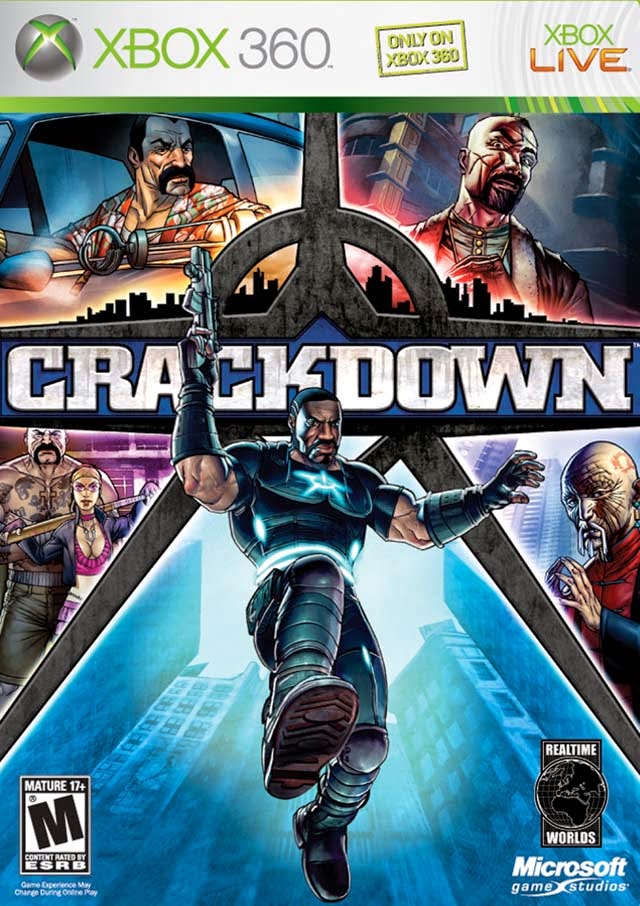
The mood to sandbox: an overview of Crackdown and Prototype

As I've established, the mood tends to strike me to play a specific game, series or even particular genre. Recently that particular genre was the sandbox, which I suppose is more like a style of game rather than a genre, but whatever. Sandboxes are a favorite of mine. I like virtual worlds, I like to explore, and - while I am also a fan of simple, relatively linear games - I like broader games with lots of freedom sometimes too. During this mood I made it through two slightly older games I'd never played before: Crackdown and Prototype on the Xbox 360. I enjoyed both significantly.

Crackdown could well receive my award for best Xbox 360 exclusive (not that such an award exists). I've been interested in it since I saw it played back when it was a launch title for the system and I'm glad I finally made my way to it. It only took a few days to go through it, but it was a great experience. I liked the game's simplicity, roaming the city at my own pace, searching for collectibles and going after gang leaders as I went. No missions, no hand holding - just you (a genetically-enhanced super cop), a general premise of what to do and very little keeping you from going about it however you want. That Crackdown is short yet very replayable is also a strength in its’ favor.

Finding the location of a gang leader, learning the boundaries of their area and then choosing usually one of several entry points to begin a bloody path toward the target is certainly fun and an element central to the experience. That said, I spent the majority of my time with Crackdown by doing super jumps from rooftop to rooftop, seeing the sights of Pacific City and occasionally shooting a rocket launcher at a cluster of gang members. It didn't get old and honestly it wasn't long enough to wear on me, so I look forward to a similar experience when I feel like going through it again (your agent becomes more powerful at various skills the more you use them and the game does have a "new game+" style option, so there’s also that).

Another perk of Crackdown: I found it used for a couple bucks. Money well spent.

Moving on, I’m going to now talk about Prototype. How I let this game pass me by until now is practically beyond me, but at least I've now remedied the situation. There’s just something about this game that makes it particularly appealing to me. It’s another game where you have superpowers but the word "superpowers" isn't nearly description enough. Sure, the player character (Alex Mercer, a freakish shape-shifting antihero) can change his limbs into various accouterments like a blade, claws or a shield, but that’s just the beginning.

Mercer can run up buildings from street level to the top of the tallest skyscraper, and he runs fast whether it’s on the ground darting over vehicles or at a more gravity-challenged angle. He can leap over several buildings. He can glide and do air dashes, which can turn a single jump into a vertical maneuver spanning the length of a city block or two. He can consume any character in the game’s world, taking their appearance if they are human, which comes in handy mostly for sneaking into military bases. He can rip open tanks from the top, climb inside and take command of the tank, which for this game is one of my favorite versions of this powerful military vehicle I've encountered. One thing I've regularly done with Mercer is had him run across the sides of buildings along Time Square, leaping back and forth between buildings as I went. He can do all these things, and much more, all while the game does well to show the speed and strength he has.

So like Crackdown, it largely comes down to mobility and how fun it is to get around in the game world, which Prototype excels at. The combat is fine too and there’s certainly a lot of fighting in the story missions. Outside the story missions you can pretty much do whatever, but a small complaint I have is the shallowness of other activities open to you. Like Crackdown it has collectibles scattered around the city, but unlike Crackdown these collectibles are somewhat difficult to spot and not really worth the effort. It also has various challenges, mostly combat with some more obstacle course ones thrown in, but these are mostly uninteresting. Despite all my praise for how fun it is to get around, I do kind of wish the game also had a truly long-range travel option, because there’s only so many times I can go from one end of Manhattan to the other, jumping and gliding the whole way, before it gets old.

I could talk about the story a bit, although I don’t want to delve deep. I’ll just say it plays somewhat like a mystery and is told in a very fragmented fashion. Going through the game normally and consuming certain targets gets you memory scraps (usually pretty creepy scenes) to help you piece together what happened. These scraps get added to a "Web of Intrigue" menu screen, where these scenes can be watched again, ordered in how the people involved relate to one another to help get a bigger picture of what’s going on. It’s a largely optional system, but it’s certainly unique.

Oh yeah, besides the military enemies there is also a faction of infected who are essentially zombies for the most part. Zombie-themed movies and other media are kind of a guilty pleasure of mine (I feel the phrase "guilty pleasure" is sometimes said flippantly, but in this instance I mean exactly what I say), so it has that going too for Prototype’s appeal to me. The game’s overall tone is bleak, bloody and disturbing, which neither really helped nor hurt it in my eyes.

When I was first considering this game, I thought about going directly to Prototype 2, but I’m glad I decided to begin with the first. Mercer isn't exactly likable, but it was interesting being in his shoes for a while. I plan on getting to the sequel eventually. Unfortunately, from what I gather, the likelihood of the franchise making it to a third installment seems slim. Also, one last random thought on the game, exactly how many collars does Mercer need? The more I look at the amalgam of what he’s wearing the more ridiculous it gets. It was genuinely distracting in the cut scenes while I was trying to figure out how many shirts and jackets he was wearing.

For now I’m going to call my mood for sandbox games sated. After the rooftop jumping extravaganza that was Crackdown and the speedy vortex of carnage that was Prototype, playing pretty much any other sandbox game right afterward would be a difficult shift just from the mobility perspective alone. You want me to drive a car in a game? I just played two games where I could pick up a car, hop onto a nearby roof and then throw said car over several other buildings. So yeah: video games.

Thursday, May 23, 2013

So I managed an apartment building (in a game)


There are a few games I want to take some time to talk about, but since I don't quite feel like any of that yet I'm going to just quickly mention a game I recently gave a shot. The game is One Piece Mansion for the PS1 and one thing that can be said about it is it's unique. If you are familiar with the Japanese manga and anime called One Piece, it's important to note this game has nothing to do with them whatsoever. I understand the word mansion in Japan is used to refer to an apartment building with thick walls, and that's about the extent that I can explain the game's name.

Anyhow, in the game you are a landlord who manages their apartment building by placing and moving tenants and rooms. Some tenants have positive effects on their neighbors, others have negative effects. If a tenant's mood takes too much of the latter they leave and you take a monetary penalty. So at first glance it becomes a matter of placing everyone so all their moods are more or less balanced, but another twist comes in with criminals who come into rooms and cannot be moved. You essentially need to "attack" these criminals by placing unpleasant tenants near them to get them to leave. Since the criminals are always coming and going, the need to constantly move tenants around never really ends. You can also take direct control of the landlord and move around the building, which is necessary when criminals leave their rooms and need to be shooed away before doing something like set fire to a tenant's room. Things can get frantic and chaotic quick.

I don't usually feel the need to give a detailed explanation of a game (since such descriptions can easily be found elsewhere typically) but an exception here is that this game is a rather unique puzzle game and also a pretty obscure one as well. When I heard about the game I was intrigued, so I thought it was worth sharing. Unfortunately, this may end up being somewhat of a tease because at time of writing it's not easily available like many PS1 titles in the Playstation store, so you would actually need to get access to the PS1 disc to play. It's also a very short game. Over the course of a few days of light playing I've finished off the story mode twice and tried the equivalent of a survival mode a few times, and that's about the extent of what the game offers.

So if it sounds interesting and you get the opportunity to try it, have at it.

Saturday, May 11, 2013

Review: A new Castlevania approaches... in 3D!

So I guess I'm going to talk about another game for the Nintendo 3DS, that game being Castlevania: Lords of Shadow - Mirror of Fate this week. A few times now I think I've mentioned that Castlevania is among my favorite series. However, I don't feel that completely includes the Lords of Shadow games, which are practically a different beast altogether. Lords of Shadow is a reboot essentially, although I like to think of it more as a project of some new hands trying to get in and do their own thing and then get out before they overstay their welcome.

All that said however, I enjoyed the first Lords of Shadow game and I enjoyed this one as well. Yahtzee's Zero Punctuation review of the game on The Escapist heavily compared this game to God of War and at one point jokingly calls it 'God of War: Germanic Mythology Edition'. Honestly, that's relatively accurate. It does feel like God of War in many ways. While there are token Castlevania elements like a guy whose last name is Belmont and many of the standard vampire hunter weapons, a significant portion of the game felt like it had no business being named Castlevania.

I mention this because Mirror of Fate feels significantly more like a Castlevania game. There are familiar faces like Simon Belmont and Alucard (not the same versions of them but still), and now the entirety of the game takes place in and around Dracula's castle. That's actually a pretty bad explanation of how it has the good old Castlevania feel, but maybe it will become clearer as I go along. You explore the areas of the game in a method similar to the 'Metroidvania' titles like Symphony of the Night. Unfortunately, although there are many side paths and little nooks tucked away, most of the areas of the game are very linear. It's more like if a series entry such as Super Castlevania IV were mapped out but the game allowed you to backtrack to earlier areas, with the added utility of things like unlocking shortcuts and the rare teleporter. Also unfortunately, the most interesting things you come across in the trouble spent exploring and backtracking are mostly boring old upgrades to your maximum life, magic and item capacity.

What didn't change from the first Lords of Shadow was the combat, which I didn't really mind. Granted the combat is now in a side-scrolling environment and you don't need to worry about enemies coming at you from every direction, but it still has the same combo-able feel and it's pretty fun to just wale on things. Attacks chain together fluidly, they feel like they have some real power to them, and it's easy to go into and out of aerial techniques. I didn't find the game very challenging overall and most enemies are easy to deal with. Keeping an eye open for a white glow (signaling an un-blockable attack that typically also cannot be interrupted) and a finger over the dodge button is enough to casually deflect most of the danger the typical enemy offers. Bosses are another story as their massive amount of life and powerful attacks mean memorizing their attacks and looking for openings is the way to go usually. The frequency of checkpoints does offset the difficulty the bosses offer by a lot though.

The look of the game is one of its' strengths I think. Plenty of interesting architecture, varied areas and relatively detailed environments along with some nice enemy design all go toward this strength. Castlevania games are generally known for looking and sounding pretty good, but I didn't think as highly of Mirror of Fate's music. I'm not saying it was bad, but I found almost instantly forgettable. Sound effects were better.

Mirror of Fate's story is relatively interesting, although difficult to talk about without revealing certain things. You play Simon Belmont, Trevor Belmont and Alucard, taking different paths through the castle and dealing with different challenges. After the rather unique ending of Lords of Shadow, I went into this game expecting something similar. In this I was disappointed. I saw the story's big twist coming a mile away. Other parts like the explanation of the masked creature and the titular Mirror of Fate itself fell completely flat for me.

I have my complaints with the game, but I will say I enjoyed it for what it is. I wouldn't be against seeing another game like it. However, it in no way replaces the 'Metroidvania' games of the series. These offer a certain something that Mirror of Fate just can't.

My rating: 7.5/10

Thursday, May 2, 2013

Retreading the legend... in 3D?

Obviously, it has been awhile since my last post. So, that said, moving on.

Awhile back I went and played some game called the Legend of Zelda: Ocarina of Time. Apparently it has some name recognition. Okay, to be more technical I replayed it for... I don't know, somewhere in the vicinity of the fourth or sixth time? But ah ha - it was the first time I played it on the newfangled Nintendo 3DS doohickey (says the guy who bought it nearly two years after it came out).

So how did it stand up? Approximately the same, which is to say approximately the same amount of awesome. I mean, it's Ocarina of Time, it really doesn't need to be elaborated on too much unless I'm talking to someone who really needs to brush up on their Zelda's.

The most noticeable thing about the 3DS version is some highly polished visuals. Then I looked between the new polish and what it looked like on the N64, and I realized just how significant an upgrade it was. The textures are now greatly improved and look much nicer. Overall the game looks more detailed and less murky. Many objects also have quite a few more complex polygons for their model. A good example of this is to compare the roots of the tree-like houses in the Kokiri village between the versions. Yet, it struck me as odd that so much was done on this front but the angles and such of the environments themselves were essentially copy and paste. It doesn't bother me really and I guess it goes along with the game providing a more perfectly accurate translation of the gameplay, but I wouldn't have minded if the very unnatural angles in the mountains, hills, cliffs and the like were given a more stylized look.

The only thing that really bothered me is there are a few icons on the bottom screen that must be touched to use - there is no button for them. Considering there are three directions of the D-pad that more of these functions could have been mapped to (in addition to being functional as touch screen icons), this was a baffling design choice. My hands hurt playing this game due to the way I naturally hold it to use L targeting. Although some extra button mapping probably wouldn't change that, it might have helped a little.

To kind of undermine the praise and fanfare I introduced Ocarina of Time to in this post, I will say it's not my favorite Zelda game. That honor goes to Wind Waker on the Gamecube. It's not even my favorite Zelda title on the N64. Gasp! That goes to Majora's Mask. But, you know, Ocarina of Time is still up there. Wind Waker I love for so many reasons: the unique art style, the ocean setting, the finely tuned gameplay, the fun exploration, the merging of new and classic ideas, and more. Majora's Mask... is harder to define. To simple it up, I'll just say it fits my tastes better. Also, I love the creepy moon, the mask transformations, the day/night passage combined with the schedules of people in town, and all the bizarre moments the game offers.

I haven't talked about the 3DS before, so I guess I'll go ahead and say I think the 3D functional is an unnecessary gimmick (again, says the guy nearly two years late to the 'party'). I don't hate it, but it's not something I'm interested in. From my experimenting with the 3D slider and after careful analysis, I've determined it results primarily in headaches. I also am not sure my eyes pick up the 3D in an optimal way. Still, I think it can have some extremely marginal value so I keep the 3D on the most minimal setting possible. That way there's some visual addition from this gimmick that's supposed to be a selling point on this thing and it doesn't seem to cause the headache effect. Other than the stupid 3D, it's basically a more powerful DS, which is far from a bad thing.

Sunday, July 1, 2012

First impressions of Blizzard's polarizing new game

Saying first impressions is a bit deceptive because I have actually beaten Diablo III on normal already, but I'm not in the mindset to review the game. I'm moving through nightmare difficulty with my first character, a demon hunter, and going through it the first time with my second character, a wizard. I've certainly been enjoying D3, but it has some flaws. Knowing Blizzard, they'll be updating the game bit by bit for years to come alongside an inevitable expansion pack or two, but saying this does not negate any current problems.

For now I'll briefly mention some of the main things that stood out to me. I think the game's interface has been improved and streamlined considerably from D2's, making for a smoother experience while removing some annoyances that just plain weren't fun. Health globes and more readily available resources to use skills keep the action flowing much more so than the game's predecessors. I like that I can customize my characters' skills anytime, allowing me to try new things and find combinations that work well rather than feeling nervous about every precious point I received to allocate in D2. My characters feel like they're powerful, able to handle the onslaught of foes before them, and this is a good feeling.

Now for a few things I don't care so much for. I don't particularly like that D3 is even more gear dependent than D2, although this isn't as big of hit against the game as it would be if this is something I'd merely heard before actually playing it. The auction house is certainly something I'm ambivalent to at best. What really annoys me though is that it must be played online even if I'm playing single player (which is how I play it), although this is something I knew about well in advance and prepared myself for.

Those are my first impressions in short. I have more I could add on what has been mentioned so far, but I'm holding off at least for now. Overall though I definitely like the game, but I am beginning to see why it has become very polarizing among its' players. I've heard from many people who really like the game and probably from even more who definitely do not. With the fame of D2 to live up to, it's understandable how the game is bringing out strong feelings.

Saturday, June 23, 2012

A Diablo of a finer vintage

I admit I was pretty hard on Diablo (henceforth D1 with similar abbreviations, etc.) in my earlier post on it, especially because it was a game that very adeptly mixed many different types of gameplay for its time. The main thing I was getting at was despite this the game has not aged well and the biggest reason why is its sequel did so much to improve the formula that it made it difficult to go back to its predecessor. High praise for Diablo II actually. A more factual tidbit to support this praise is that to this day D2 remains on many top 10 lists for PC games and after 12 years it is still readily available pretty much anywhere that sells computer games. Outside of another of Blizzard's prize stallions, Starcraft, this is unprecedented.

It maintains the addictive mix of exploring, killing evil things and finding loot that D1 had and improves substantially on the formula. In D1, there's one small town and one very deep dungeon (essentially), but D2 is composed of four acts plus a fifth with an expansion and besides Act IV they are each individually larger in scope than the entire first game. The first major addition is the over world of large open areas to venture into the countryside, finding both essential and optional dungeons to explore along the way. Instead of painfully plodding along you can now run, moving faster from place to place and in combat situations. While I normally wouldn't count running as a big advancement for a game (I would think it'd be a given actually), it does wonders to improve upon D1. D2's predecessor, as I mention in my overview of it, was not only slow but extremely restrictive to move around in and this hampered gameplay significantly. No longer are enemies that can teleport or run away the bane of my character's existence; yes they still exist and are annoying, but they don't stop the game from being fun.

On the topic of fun, another big difference is the diverse number of ways the game can be played. In D1, the classes respectively specialized in melee combat, ranged combat and magic, but basically they could all do the same things (a warrior could use magic, a sorcerer could wield swords). The main thing separating them was their attributes affecting how well they could do various actions. D2 vastly improves on this by offering five classes, plus two with the expansion, that are vastly different from each other. Each have their own unique abilities and beyond that, their skills can individually be customized in many different ways. The sorceress for example has skill trees for fire, ice and lightning spells and generally players who use her will want to focus on specific spells within two of the three skill trees, but if you want to be creative it's possible to use all three or just specialize in one (although I wouldn't recommend it for higher difficulties).

I chose barbarian this time around because it's the only class I haven't bothered to go through the game with. Now having done so, I can't say I regret my decision to ignore him. It wasn't difficult to take him through normal, but I found him very dull compared to the other classes. His is a very gear-dependent class and one problem I have with D2 is when the right gear becomes necessary for a character to advance. Now when I say the right gear I don't mean the crap the NPC merchants sell or the majority of what enemies you kill drop, I mean stuff you have to be very vigilant or lucky to find. I don't want to run a section of the game ad nauseam, fighting other players on who can click on the good loot drops first (if playing with others), to advance. Now my barbarian had a bit of an inferiority complex to my Act II mercenary for most of the game and even though completing the game wasn't really a problem, I felt weaker than I should have for most of it. I'm not sure how many other players share my feelings on this, but as someone who has only intermittently played the game I've often felt very outclassed when it comes to gear. Even though it's meant to be a loot-driven game, there's something about how the formula actually works that I've never been happy about.

Like D1, D2 certainly looked good for its time and to this day its' relatively detailed sprites give it strong visuals and art direction. I'm not the biggest fan of rendered graphics, which is what Blizzard used for both D1 and D2 along with Starcraft. For those who don't know, rendered graphics involves first making a 3D model of something like a character and then creating a 2D sprite of that model. It allows the game to display an approximation of the 3D model without causing the demand to actually render it. Rare of old had considerable success with this for the Donkey Kong Country games on the Super Nintendo. The Golden Sun games on the Game Boy Advance also made passable use of the technique. Although as I said I'm not big on this method in general, Blizzard is certainly experienced at rendered graphics and D2 may be the game that used them best.

When it comes to sound, D2 is again very similar to D1 with largely atmospheric background noise and music belittled by the number of whacks, spell flinging and groans you are more likely to hear. The amount of character dialogue is considerably increased and this is welcome. Besides Deckard Cain and very occasionally the witch Adria, nobody in D1 had much that was terribly interesting to hear. Plenty of new characters occupy D2's few safe havens and most have remarks to pass on about the world and the story, although I imagine most people completely bypass this section of the game.

Despite all the good, I'll admit I've grown a little tired with the game. I've played through it about four times with my favorite class, necromancer, and at least once now with all the others. However, the game has amazing replayability and even now I would still like to try out some of the available characters in different ways. It's just that I have to be in the right mood to play (same as everything really) and these moods are becoming more infrequent.

I am somewhat disappointed in Blizzard's present lack of support for the game on modern operating systems like Vista and Windows 7. Yes, the game is 12 years old and normally I'd give a developer a pass for not keeping a game up after so long, but D2 is still widely available in a battle chest where computer games are sold as I mentioned previously. I don't understand how they can continue to keep the game in stores but leave it a nightmare to get to work correctly on modern computers. Choosing to run it in compatibility mode didn't even begin to fix it for me or for many from what I've read. It took quite a bit of research to find a solution after going through multiple ways others used with the same operating system version as me.

Now that I'm finally finished with D2 I'll at long last be getting Diablo III. Hopefully my computer will be able to handle it well enough. I've been a bit torn between choosing the demon hunter or the wizard as my first character, so depending on how things go I'll post next weekend on my first impressions of the game.